Gabriele Brandstetter
SHELTER-BONE ist ein multimediales Projekt und Ausstellung in HAUNT/Frontviews Berlin des Künstlerduos Mario Asef und Kirstin Burckhardt, das sich mit Architektur, Natur und Formen von Schutz in Zeiten globaler Krisen auseinandersetzt. Ausgangspunkt der Arbeit sind Recherchen in The Sea Ranch in Kalifornien, einer in den 1960er-Jahren entwickelten Siedlung, die als visionäres Modell ökologischer Architektur und eines neuen Verhältnisses zwischen gebauter Umwelt und Landschaft gilt.
Die Ausstellung reflektiert die Transformation natürlicher Ressourcen, verhandelt Intimität und Fürsorge in Krisenzeiten und befragt die Aktualität dieser utopischen Siedlung vor dem Hintergrund von Waldbränden, Klimawandel und ökologischen Umbrüchen.
Im Artist Talk sprechen Mario Asef und Kirstin Burckhardt mit Gabriele Brandstetter über ihre Ausstellung und ihre künstlerische Praxis.
Gabriele Brandstetter ist Theater- und Tanzwissenschaftlerin und ehemalige Professorin an der Freien Universität Berlin, wo sie das Zentrum für Bewegungsforschung leitete. Für ihre Arbeiten zu Tanzgeschichte, Körperbildern und Performance wurde sie 2004 mit dem Gottfried Wilhelm Leibniz-Preis ausgezeichnet. Sie ist Mitdirektorin des Internationalen Kollegs Interweaving Performance Cultures und wurde 2026 mit dem Deutschen Tanzpreis geehrt.
Elena Engelbrechter
SHELTER-BONE handelt um ein multimediales Kunstprojekt des Künstlerduos Mario Asef und Kirstin Burckhardt, das sich mit Architektur, Natur und “Schutz” in Zeiten globaler Krisen befasst.
Die Arbeit basiert auf Forschungen in der “Sea Ranch” in Kalifornien, einer Siedlung aus den 1960er Jahren, die ökologische Architektur und Natur verbindet.
Die Ausstellung thematisiert die Transformation natürlicher Ressourcen, Liebe in Krisenzeiten und hinterfragt die Relevanz dieser utopischen Siedlung angesichts von Waldbränden und Umweltkrisen.
Die Ausstellung SHELTER-BONE Lieben in Krisenzeiten wurde von Stephan Klee für den Kunstverein Göttingen kuratiert.
Elena Engelbrechter kommt vom Kunstmuseum Wolfburg, um mit dem Kunst–Duo und Paar Asef–Burckhardt ein Podiumsgespräch zu führen. Elena Engelbrechter ist Kuratorin und Leiterin der Sammlung in Kunstmuseum Wolfburg und zusammen mit Andreas Beitin bekamm für “Re-Inventing Piet. Mondrian und die Folgen” den Preis für die Ausstellung des ART-Kuratorenpreis des Jahres 2023.
Sven Spieker
“MOTHER-BURN” is the second video of a trilogy by the artist-couple Asef-Burckhardt. It was filmed on-site in the burned remains of a Redwood tree grove in the ecologically avantgarde architecture project “The Sea Ranch” in Northern California. Based on extensive periods of research there, Asef-Burckhardt created videos, drawings, paintings, performance, sound, photographs and poems produced on site and in Berlin. Their multimedia project is continuously expanding and shown in changing settings at exhibition venues in different countries.
Artist Talk and Guided Tour with Mario Asef, Kirstin Burckhardt and Sven Spieker (UC Santa Barbara, California) June 14th at MOS Art Center, June 2025.
Curated by Bartosz Nowak
Sven Spieker is professor at UC Santa Barbara. His research focuses on transnational modern and contemporary art, with a focus on Eastern Europe, Soviet and post-Soviet space, and Central Asia. He is also interested in aesthetic theory at the intersection of philosophy and decolonization. He published about diverse topics including the archive and contemporary media theory; destruction in art; the problem of acousmatic sound; as well as 19th- and 20th-century European literature and film. Spieker is the founding editor of ARTMarginsand ARTMargins Online as well as a co-founder of the Working Group Cultures of World Socialism. His experience as a curator includes an exhibition of East-German artist Ruth-Wolf Rehfeldt at the National Gallery in Tirana, Albania.
Isabelle Malz
MOTHER-BURN is the title of the exhibition at @wildpalms in Düsseldorf and the second video in a trilogy by the artist duo Asef-Burckhardt.
Developed in the burned remains of a redwood grove within the legendary ecological settlement project The Sea Ranch on California’s northern coast, the work brings together video, drawing, painting, and performance. In MOTHER-BURN, Asef-Burckhardt explore what remains of the architectural utopias of the 1960s when they encounter the climate crisis, recurring wildfires, and the contemporary logic of speculative coastal real estate.
In their Artist Talk, Mario Asef and Kirstin Burckhardt spoke with Isabelle Malz (Kunstsammlung Nordrhein-Westfalen, Düsseldorf) about their exhibition and practice.
Isabelle Malz studied art history, philosophy, and French literature in Basel and Bochum. In 2007 she completed her PhD with the dissertation on the image processes in the video works of Gary Hill. Among many exhibitions she has curated “I’M NOT A NICE GIRL! Eleanor Antin, Lee Lozano, Adrian Piper, Mierle Laderman Ukeles” (2020), “Katharina Sieverding” (2024/25), and most recently “Queer Modernism: 1900–1950” (2025/26). Since September 2007 she has served as curator at the Kunstsammlung Nordrhein-Westfalen in Düsseldorf.
Sabeth Buchmann
TEXTE ZUR KUNST
THE MATTER IS THE MESSAGE Sabeth Buchmann on Asef–Burckhardt at MOS Art Center, Gorzów Wielkopolski
If everything had gone according to plan for the Sea Ranch – a famed planned community and interdisciplinary group of creatives conceived of and first established in the early 1960s on the California coast – its decidedly inclusive community spirit would have remained at the project’s center. But as is so often the case in capitalist systems, economic interests got in the way. Focusing on the formative impulses that Anna and Lawrence Halprin contributed to the settlement, the artist duo Mario Asef and Kirstin Burckhardt are currently examining the Sea Ranch’s structural and ideological concepts in a series of exhibitions. Sabeth Buchmann visited the second iteration, in Gorzów Wielkopolski. Here she reviews a mimetic-critical engagement to which Asef and Burckhardt subject the Halprin legacy while they, at the same time, render it relevant again through an astute reversal of perspectives.
…
https://www.textezurkunst.de/en/articles/buchmann-matter-message

Alexander Leinemann
Ein Tag am Strand
Gegenwärtige Formalismen und der verlorene Bezug zur Welt
Textbeitrag: Dr. Alexander Leinemann
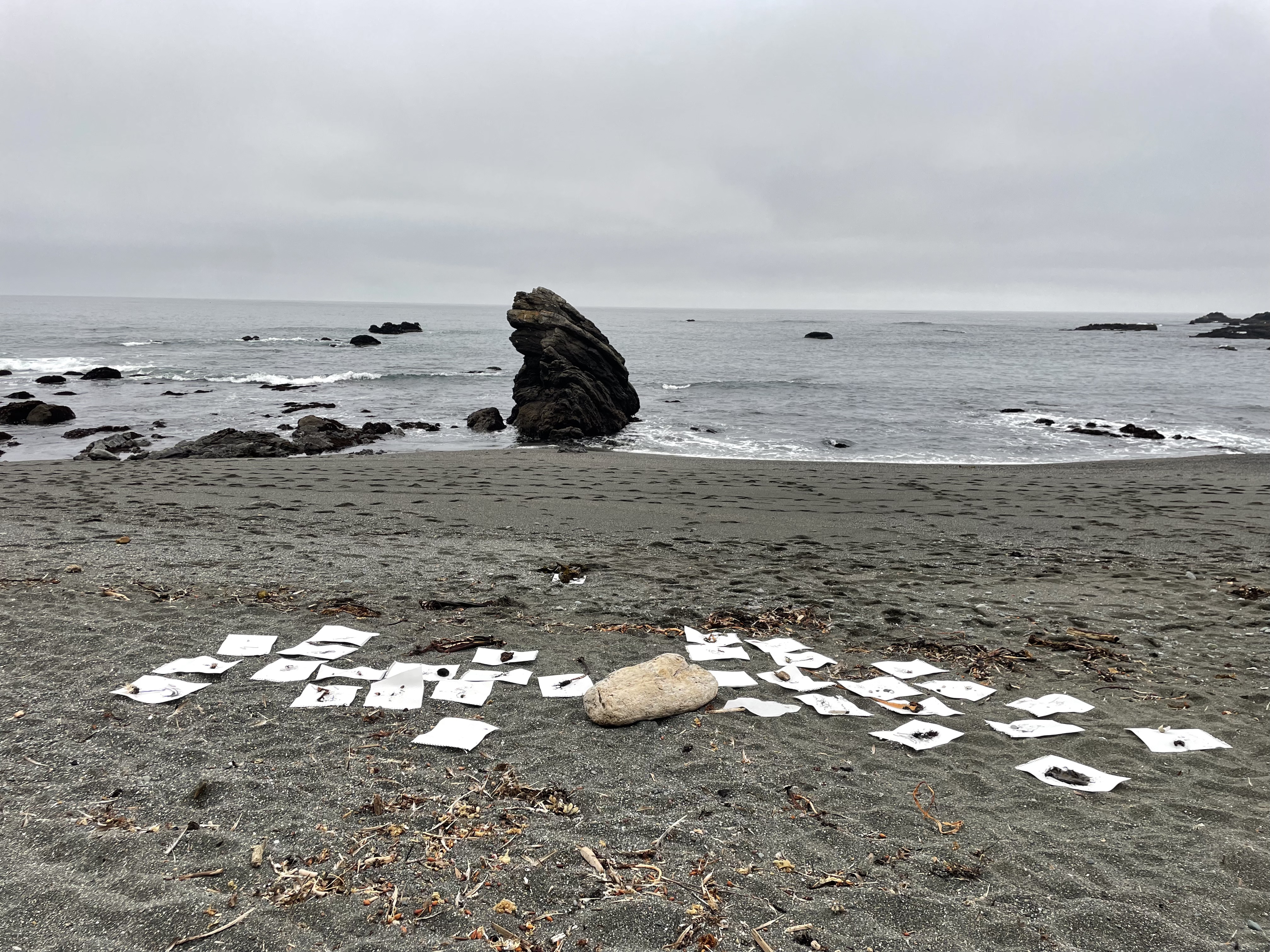
Die kleinformatigen Zeichenblätter von Kirstin Burckhardt (Durban, Südafrika) und Mario Asef (Córdoba, Argentinien) thematisieren all das, was außerhalb tagtäglicher Berichterstattungen geschieht. Die Materialbilder offenbaren die Limitierungen und Grenzen menschlicher Einflussnahme, wenn es darum geht, einen Zugang zur Welt herzustellen. Entstanden aus einfachen Gegenständen, die das Paar an einem Küstenabschnitt der Sea Ranch in Kalifornien gefunden hat, verdeutlichen die daraus resultierenden Farbsetzungen, dass jeder Eingriff des Menschen Spuren hinterlässt, die in ihrer Erscheinung nicht vollständig absehbar sind. Asef-Burckhardt haben ein Bildwerk geschaffen, das in vielerlei Hinsicht neue Denkansätze ermöglichen kann. Doch genau dieses Umdenken stößt auf Widerstand, da es die Fähigkeit zur Akzeptanz des Abstrakten erfordert – einer Dimension der Welt, vor der der Mensch jedoch beharrlich zu fliehen versucht. Wodurch ebendiese Abkehr bedingt ist, wird in diesem Beitrag thematisiert.
…